Museums in Action!
Katherine Luu
About Me!
Childhood Heroes
KAM Volunteering
Guest Speakers
Spurlock Museum Visits
Seminar & Museum Proposal
Artist Bio
Me!

Get-to-Know-Me

Work Example


Hello! My name is Katherine but I go by Kath. I am an art education major looking to teach elementary arts.My work mainly involves my personal interests— these being games, shows, books, and animals. I like to believe I have a distinct style that involves many curves and pointed edges in my work. In terms of mediums, mostly everything I create is physically drawn and then scanned onto a different device so I can color and refine it, as I prefer to physicality of traditional sketching over digital. However, I also have a fondness for pen work and watercolor. In a general sense, illustration.In terms of student teaching, I have no experience yet currently, as I am planning on taking a course for it next semester. Hopefully, this will allow me to become more comfortable with my role as a future educator My work has been featured in the Childhood Heroes Exhibition. For my volunteer contributions at KAM, I have attended multiple storytimes, and staffed at numerous other events for students and children alike.

My Collages

Us Working
Storytime Group


KAM CAFÉ
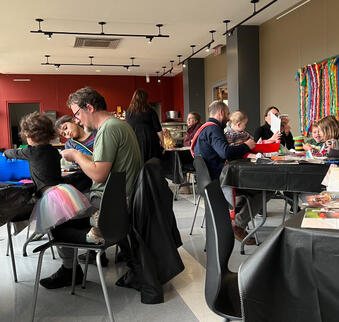
I observed that the kids were very focused during the read—aloud, and had no trouble engaging with questions Ms.Rachel asked them. I would say there was less focus during the scavenger hunt, as I noticed many of the children ignoring the activity in favor of exploring the museum freely on their own. However, I don’t believe this to be a problem since the point of the activity was to have them explore in the first place. During the collage—making, it was nice to see the kids and their parents working in tandem to create collages, either independently or working on one together. I was impressed at how everything could fit into only one hour of time, even though it felt like so much was done. I think in order for me to suggest add—ons to the child programming at KAM, I’d need to know what activities they also have planned in the future. As such, I can not think of any. The system and activity they have planned now all seem interesting and engaging.
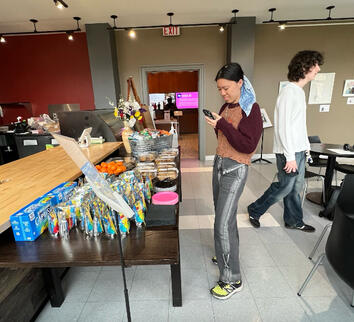
Working the Snack Table
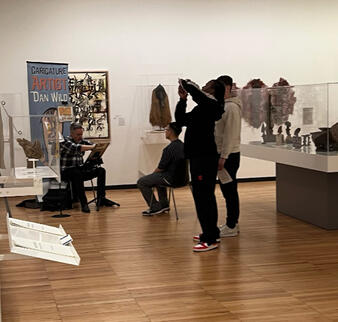
Caricature Artist
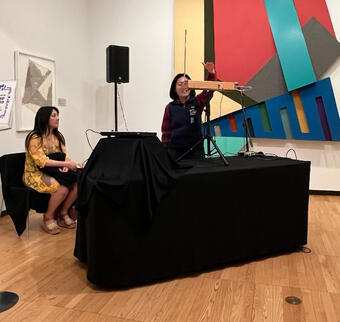
Binny Rocking Out


TEENS TAKEOVER KAM
The event began with a woman coming up to us and asking if there was any big “main” event that was going to happen at the museum. I believe all of us were confused at what she meant by this, and personally I struggled with answering it because I didn’t fully know what events were being conducted at the museum at all. After this we looked through the pamphlet and familiarized us with what was happening. In terms of us being able to leave our spots and exploring the museum, halfway through the event Rachel came over to us and encouraged us to explore the events for ourselves, and that we didn’t need to be at our duty spot (handing out refreshments and food to people) the entire time. One person did need to stay though, so we all rock—paper—scissored and Konrad was the one who lost and stayed at his post. Later on while Binny and I had walked around a bit, Rachel came up to us and asked whether or not we would be okay with looking after the performer’s instrument and music setup while she went on break. We accepted, but while watching it some high schoolers came over and started talking about touching the instrument. We then quickly stepped in and said that the instructor was off on break and didn’t want anyone touching her equipment. No one else tried anything after that. Overall I thought the event had many positive activities for students and even families to participate in and I enjoyed being able to watch them be creative.

Garden Tour
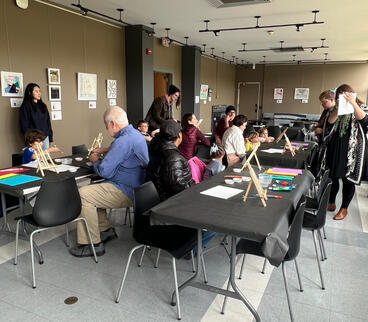
Painting Activity

Finished Paintings


STORYTIME @KAM: FLOWERS & FAIRY TALES
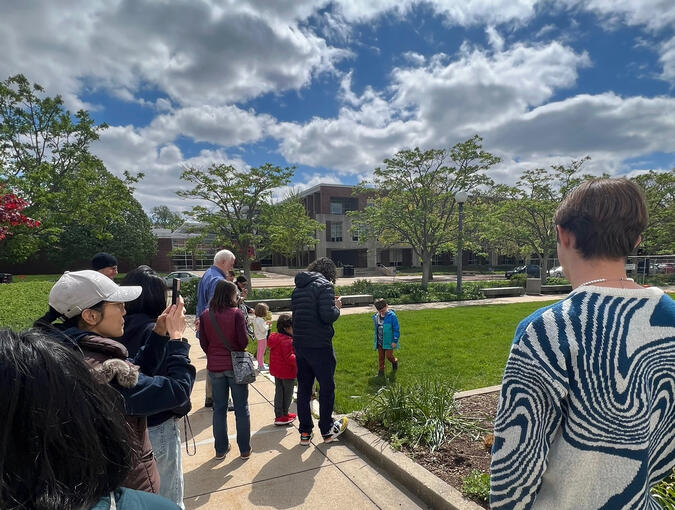
It’s very fun to talk to the parents that bring their children to these events! Often they’re very open—minded and are interested in what future events the museum holds if they notice that their children are enjoying themselves I prefer these types of events, the ones where everyone helps set up supplies and pitches in to assist the kids— as opposed to events where we are split up and doing different duties. This is just a personal preference, and I believed it was more fun, however, I do acknowledge that us as volunteers need to be split up at times for efficiency I noticed that when Rachel was reading aloud towards the kids, she asked them all sorts of questions to test both their knowledge and observation skills. Her questions allowed kids to get riled up and excitable while also being attentive towards the story. I thought this was a technique that only a really experienced educator could do so smoothly, and I admired her for it. I stored the observation away as a tool I could utilize during my own teaching career in the future. This event was unique with the fact that the community had a tour outside the museum in the gardens. Again, I am biased, because I love the KAM gardens, but I am also a large advocate for educational experiences outside the typical classroom environment. The kids were allowed to get their energy out while observing art pieces outside, and their parents were taught the history behind the little sculptures.
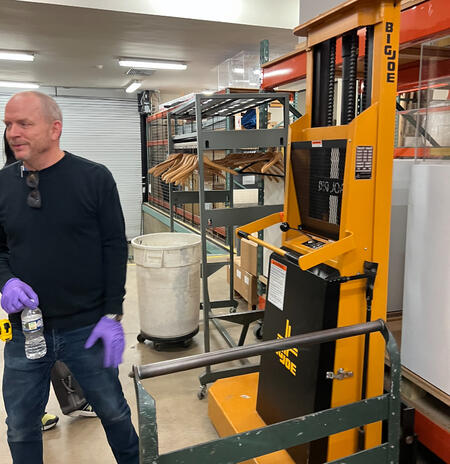
Walter’s Tour
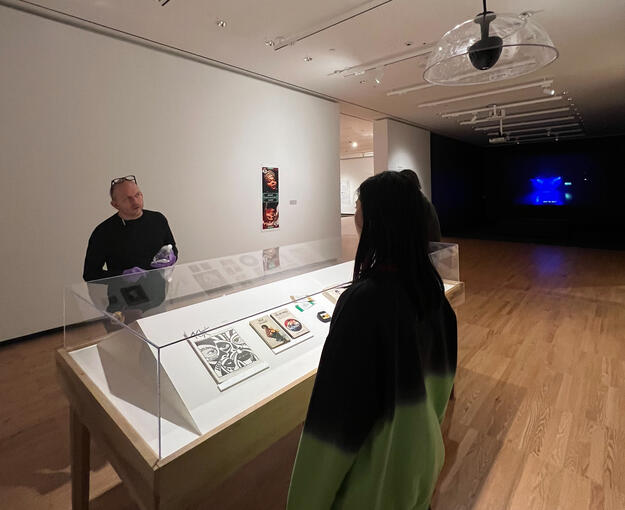
Walter explained during the tour that the one time where he witnessed a work get knocked over was when a transporter rolled a cart with a sculpture on it backwards. This was because they were not precise with their transportation. This could have been prevented if they had thought it out prior. One method Walter explained during his presentation to carefully move pieces is to put a wooden slab in the elevator doors to smoothen the process of rolling the cart into the elevator. This is required because it prevents physical objects such as pottery from jumping around. When handling large works, it is also useful to ask others for help to prevent the possibility of dropping. For works such as the little library and the sound cone in Jen Everett’s exhibit, Walter said it took a bit of trial and error in order to install them. It was mostly because of the sound system needing to play music constantly. As for the sound cone, Walker made it motion activated and also wanted to attach it cleanly to the ceiling, but ended up having to put wires against the wall. His tour was extremely informative and made me wonder if background museum curation was a possibility in my career. However, I don’t think I’m detail—oriented or meticulous enough.
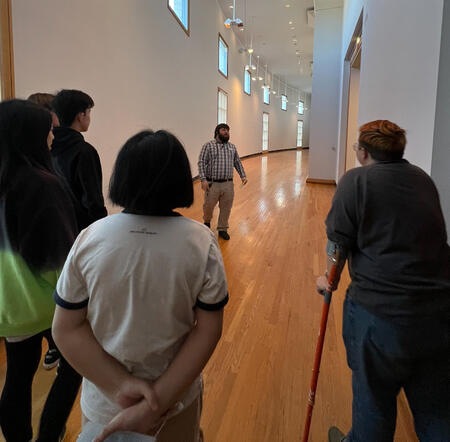
Jonathan’s Tour
Jonathan began the tour by introducing himself as the head of security at the Krannert. He had a checklist of things he wanted to talk to us about, from various topics involving how to politely keep a watchful eye on visitors to bringing us on a tour of the currently closed exhibits within the museum. Another area he showed us was part of the Jen Everett exhibit, which had the fire extinguisher in the back corner. Next to it was the thermostat that controls the humidity and temperature in the galleries, which he told us were essential in maintaining the artwork in the gallery. After, he lead us on a tour behind the scenes, to the currently closed gallery in the front of the museum that is down for maintenance, and then the area where the BFA and MFA shows are held, which had a multitude of beautiful glasswork pieces and paintings that were going to be displayed in the future. He then concluded the tour in the glass entrance of Krannert, which was also closed for maintenance. The windows had stickers on it that were testing anti—bird crash mechanics.
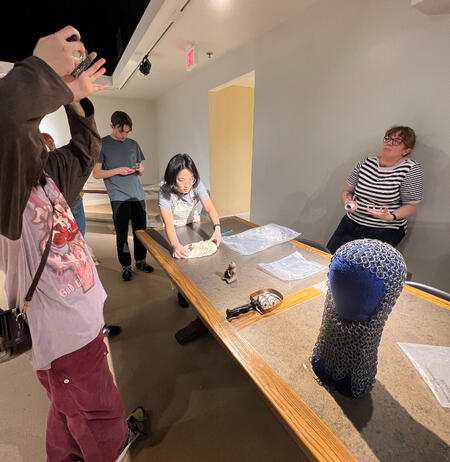
Abigail’s Tour
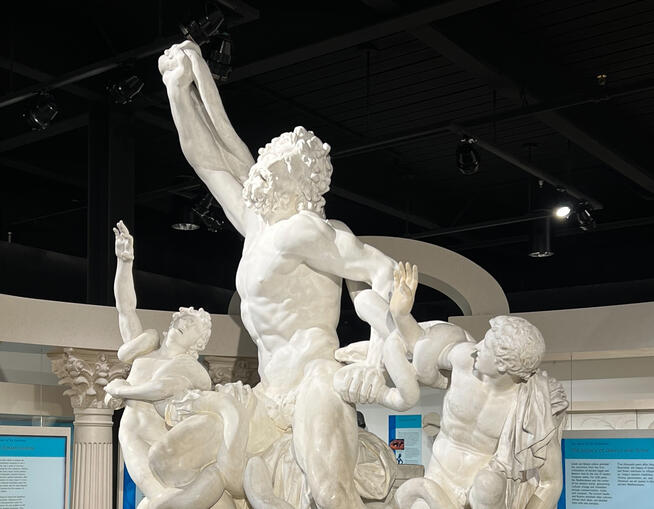
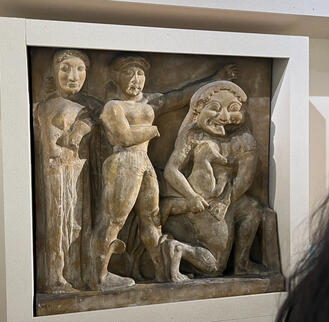
Abigail began her tour by greeting us at the front of Spurlock’s foyer area and allowed us to drop off our bags in her office. She then began the tour by leading us through the Greek and Mediterranean area, which had gigantic to—size plaster molds of multiple important Greek sculptures, such as the Laocoon. We then moved to the Native American and Latin American arts area, which she told us was the newest or most recently updated area of the museum. Here, we saw traditional powwow clothing and Pueblo pottery. After this, we went into the elevator and arrived at the European arts area, which had everything from suits of armor to relics from World War II. The Asian arts area was next, and it was a conglomerate of artifacts from Southeast Asia to currency from all over the continent, to traditional Chinese qipao and calligraphy. Our tour concluded in the African and Egyptian arts exhibit, which had some empty cases as museum staff were deciding what artifacts to put there. Abigail informed us that the museum was working with researchers in Africa to better identify how they would like artifacts within the exhibit to be displayed.
Spurlock Visitation Days
Sculpture
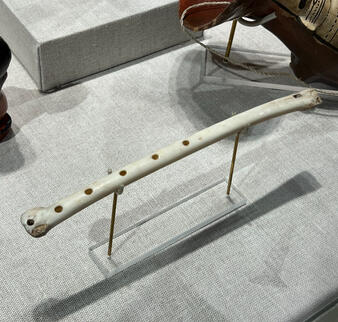
Bone Flute
Harrow


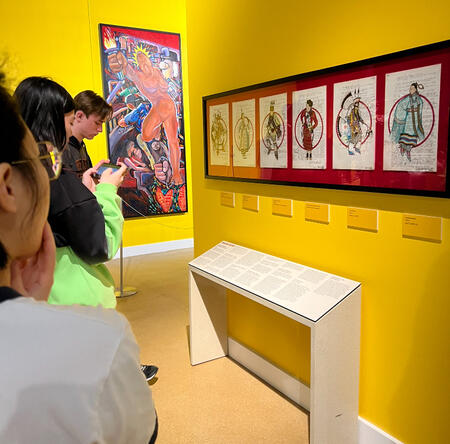
Visitation Date: 2/20/24
Reasoning of Visitation:Rachel gave us an intitial tour of the museum— leading us through the five world cultural exhibits
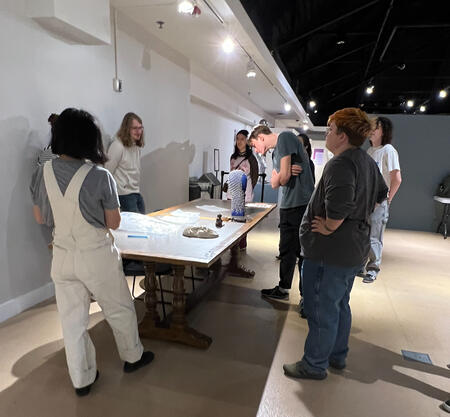
Visitation Date: 2/22/24
Reasoning of Visitation:When we returned later in the week, Rachel had a scavenger hunt ready for the class to complete. Winning allowed us to touch artifacts.
Childhood Heroes Exhibition
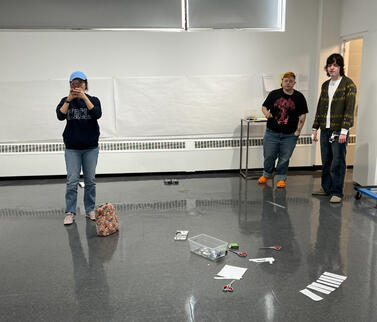
Somi Picture
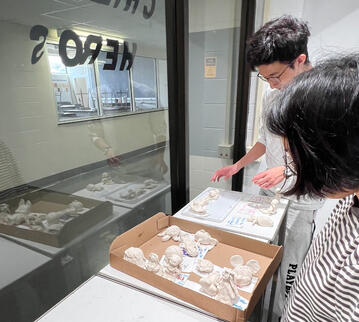
Clay Sculptures
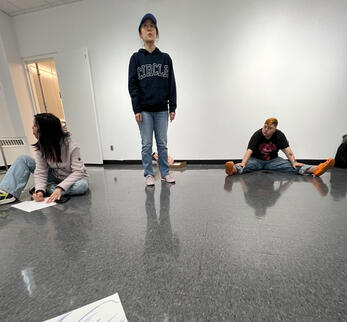
I was drawing..


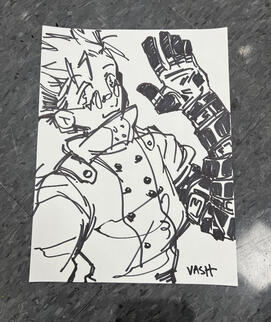
For the Wall
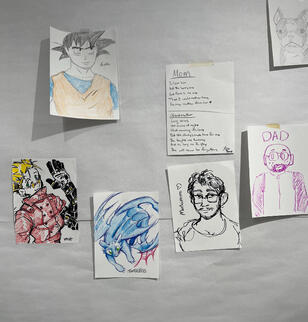
Heroes Wall
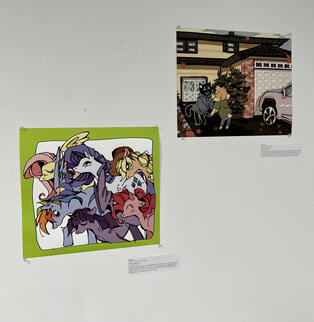
My Work!


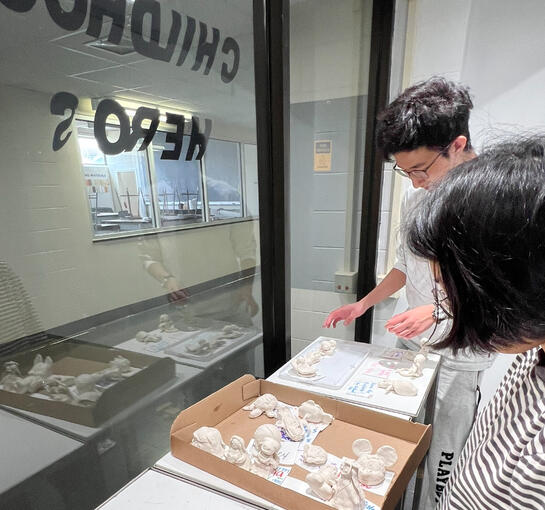
Our class’s Childhood Heroes exhibition occurred during the week of March 24–March 30; During this time, our work hung in the gallery in the Art & Design basement. To get to the point of setting up this exhibition, our class decided on roles— such as advertising through word—of—mouth, creating our own personal work to display in the exhibition, and then coming outside of class time to set everything up. We then had to come in at separate times through out the week to maintain upkeep on the exhibition and to talk to any possible visitors. When I came in, I noticed that our heroes wall had fallen onto the ground. I did what I could to tape it up again. However, it seems this was a problem for most of the week.
I enjoyed doing this exhibition— it was interesting to see who or what we all separately thought related to our conception of a “childhood hero”. For me personally, it definitely leaned heavily on the idol or character side of things. In terms of what setting up this exhibition taught me and what I would do differently if faced with the same scenario in the future, I would try to print out my work ahead of time. I never could have accounted for the fact that my art and design ID wouldn’t allow me to utilize the printers. Without my friend Tariq’s help, I wouldn’t have been able to display my work at all. The time crunch was stressful, and I’d like to avoid a similar situation in the future.
Seminar & Proposal
SEMINAR
In terms of the seminar, I didn’t end up taking any photos from when we conducted it. Matt’s seminar topic involves museum programs for young children, while Steve’s focused on students learning about the historical west and US history with an emphasis on interactive exhibits. As for my seminar proposals, my article discussed how it was harmful how often museums focused their education on artifacts as opposed to the people and students experiencing the artifacts— which are supposed to be
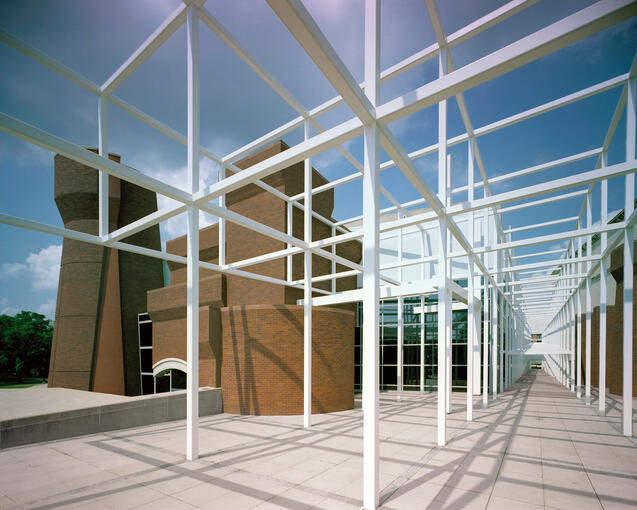
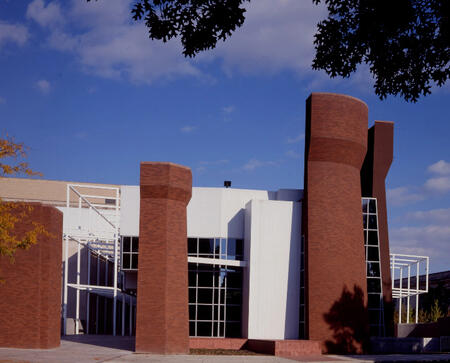
inspiring their admirers. It talked about a facility named the Wexner Center of Arts, and how this place is adamant on encouraging museums to focus less on age—old relics [correct term— object based epistemology] and instead how they should have displays that relevantly showcase “cultural forces”, which should acknowledge contemporary social issues. An emphasis of “public participation and dialogue” with museum collections is heavily encouraged, as inherently museums are places that should cause its visitors to evaluate and think about history, social issues, and human emotion.
PROPOSAL
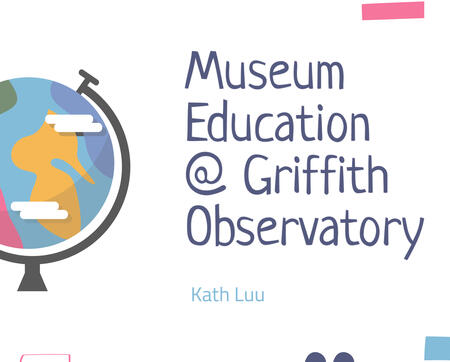
The article I chose to base my proposed event off of came from the perspective of an educator who took part in a study within the Louvre in France. She observed a study in which 6 other women, all in some way shape or form teachers and educators, observed a painting and conducted a visual analysis of it. This painting was supposed to invoke complicated feelings, as they didn’t know if they had to analyze it through the eyes of a woman, a teacher, or an intercultural mediator. The results of the activity was spoken—word, and they all reviewed their takeaways from it. The way in which this relates to my proposed activity is that children, students, will hopefully take it upon themselves to be curious and ask questions while on a field trip. This trip should occur at the Griffith Observatory and involves students taking a tour outside during the evening, in order to develop questions to ask their educators about celestial bodies or the history of the museum. This activity is supposed to allow them to have a unique learning experience outside a typical classroom setting.